
HRPT Weather Satellite Reception
Introduction
I have been fascinated with satellite communications for as long as I can remember, especially Earth observation satellites. Growing up in Sri Lanka, we even studied about Sir Arthur C. Clarke in school — the scientist who first proposed the idea of geostationary satellites, and who later spent much of his life living in our country.
Receiving satellite images was one of the first things I attempted when I got my first RTL-SDR dongle. My initial goal was to receive NOAA APT transmissions. I lost count of the number of hours I spent tweaking settings in WXtoIMG, trying to improve each pass just a little bit more than the previous one. Even though the images were low resolution two-channel images and often badly affected by local VHF noise, it was incredibly satisfying whenever a pass came out clean.
Over time I started searching for ways to receive higher quality satellite imagery. Fortunately for me, several geostationary satellites are visible from my location. These include GK-2A, Elektro-L3, Fengyun-2H, and GOES-13. Using a used 6-foot prime focus dish, I was able to receive all of them except GOES-13, which unfortunately sits behind unavoidable obstacles from my location.
I had seen other hobbyists receiving HRPT signals before, but never seriously considered trying it myself. It required tracking satellites, building a proper feed, and using filters and LNAs. Documentation was also quite limited at the time. Everything changed when Derekcz published his excellent Beginner’s Guide to HRPT Reception. After reading it, I finally decided to give HRPT reception a try. This article describes my setup and some thoughts from the experience.
My Setup
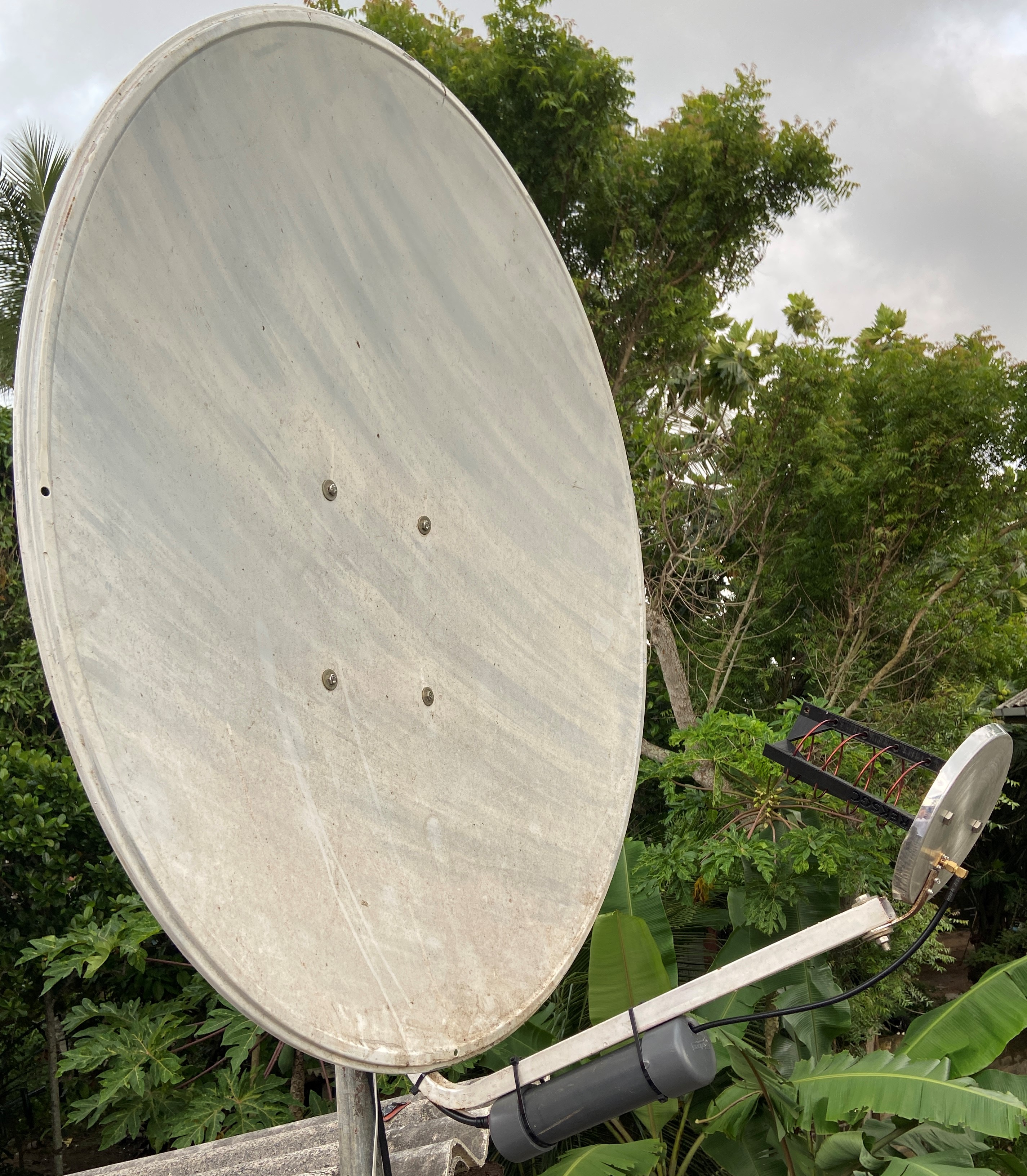 Dish Setup
First and foremost, anyone interested in HRPT should read Derekcz’s guide. It is one of the most detailed and well written HRPT resources available. That said, here is the setup I used.
Dish
A minimum 80 cm dish is recommended for HRPT reception. Larger dishes provide better signal-to-noise ratio but become more difficult to hand track. I used a 105 cm offset satellite dish that I found at a scrapyard.
Feed
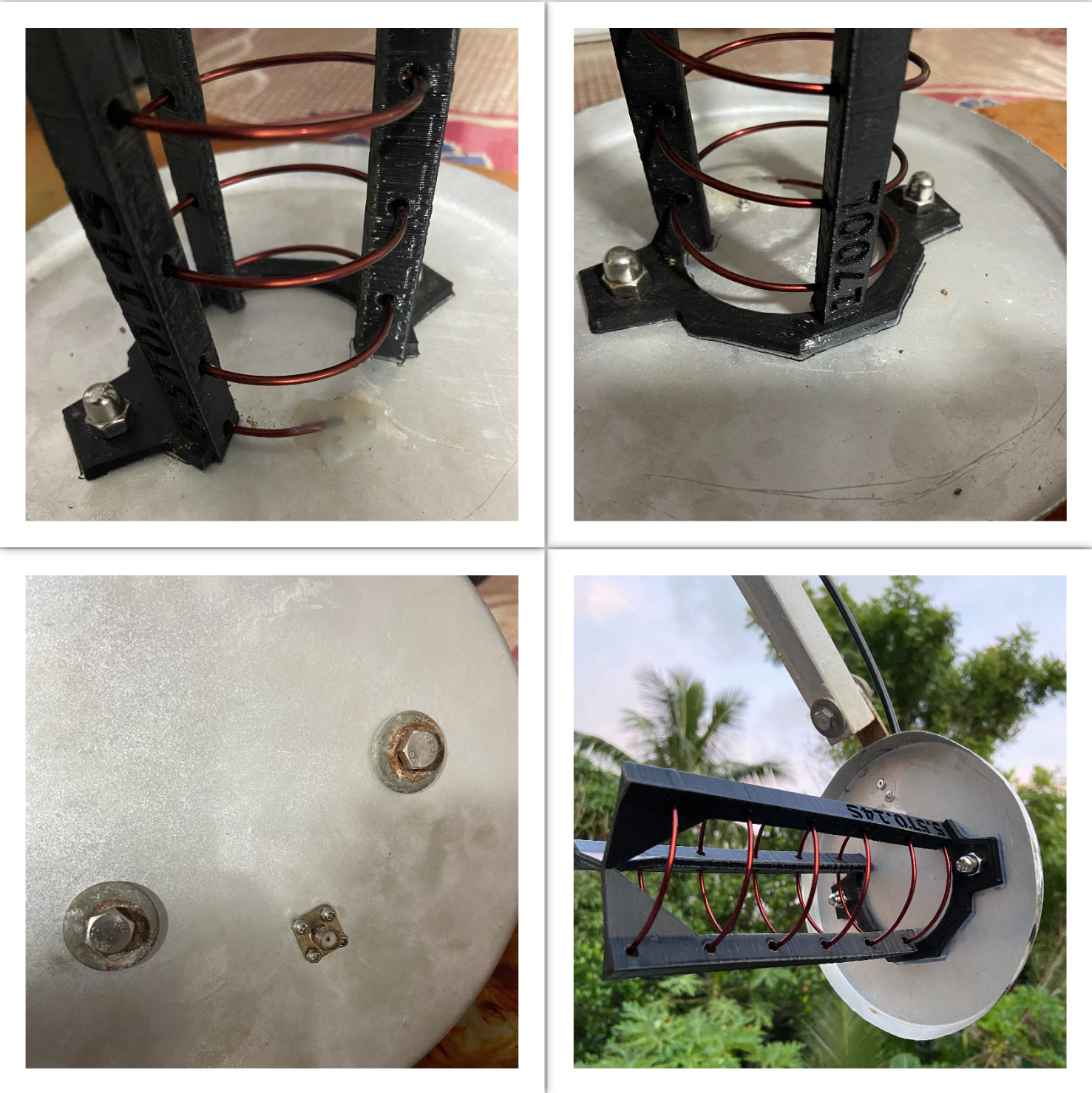 Helical Feed
HRPT signals use right-hand circular polarization (RHCP). When receiving with a dish, this requires a left-hand circular polarized (LHCP) helical feed. Derekcz provides an excellent 3D-printable helical scaffolding design on his Thingiverse page, designed specifically for 1700 MHz HRPT signals.
The correct file to use is 1700L_5.5T_0.14S_4D_10-90M.stl. Using the printed guide makes building the helix much easier and ensures the dimensions remain accurate.
Filter & LNA
A good RF filter and low noise amplifier are almost mandatory for HRPT reception. Some people report success using two cascaded SPF5189Z LNAs, but the results are generally much better when using a filtered LNA such as the Nooelec SAWbird GOES series.
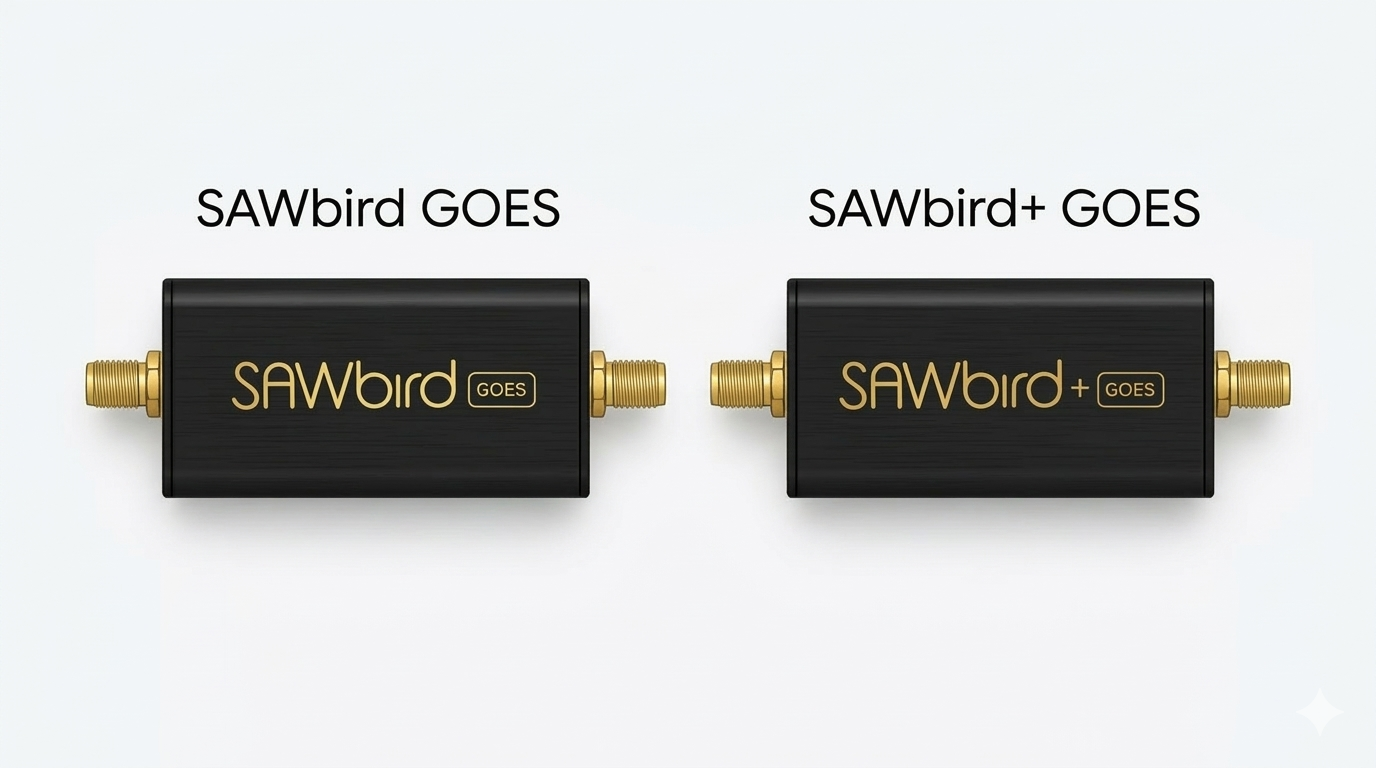 SAWbird GOES Series Comparison
SAWbird GOES vs SAWbird+ GOES
Feedline
Using good quality coaxial cable is important to minimize feedline loss and reduce environmental noise pickup. For shorter runs, RG-6 works reasonably well.
Since I did not have a laptop available for outdoor use, I had to run more than 15 meters of RG-6 from the dish to my desktop PC. To compensate for this loss, I added a second amplifier (an RTL-SDR Wideband LNA) after the SAWbird to act as a line amplifier.
Another important improvement came from reducing the number of adapters in the feedline. Initially most of my cables used BNC connectors, which required multiple BNC-to-SMA adapters. After switching to SMA crimp connectors and making custom cables, I gained roughly 2–3 dB of additional SNR.
Receiver
I tested HRPT reception with both an RTL-SDR V3 and an Airspy R2. In my experience the Airspy R2 performs better due to its lower noise figure and wider bandwidth. A sample rate of 6 Msps works particularly well for HRPT reception with the Airspy.
Dish Mounting and Tracking
There are many ways to mount a dish for satellite tracking, but the key requirement is the ability to move it smoothly in both azimuth and elevation.
I kept my setup simple. The dish mount is attached to a rotating pole using a single bolt, allowing it to pivot freely. I also added a short aluminum handle to the mount, which makes it much easier to track satellites manually.
To track passes, I first check the satellite direction using tracking software. Then I use my phone’s compass to find the approximate azimuth where the satellite will rise. I flip the dish upside down to make lower elevations easier to reach and slowly scan the sky until the signal appears in the decoder.
Once the signal is detected, I fine-tune the dish position using the SNR indicator and follow the satellite across the sky until it disappears below the horizon.
Satellite Frequencies
Demodulator & Decoder
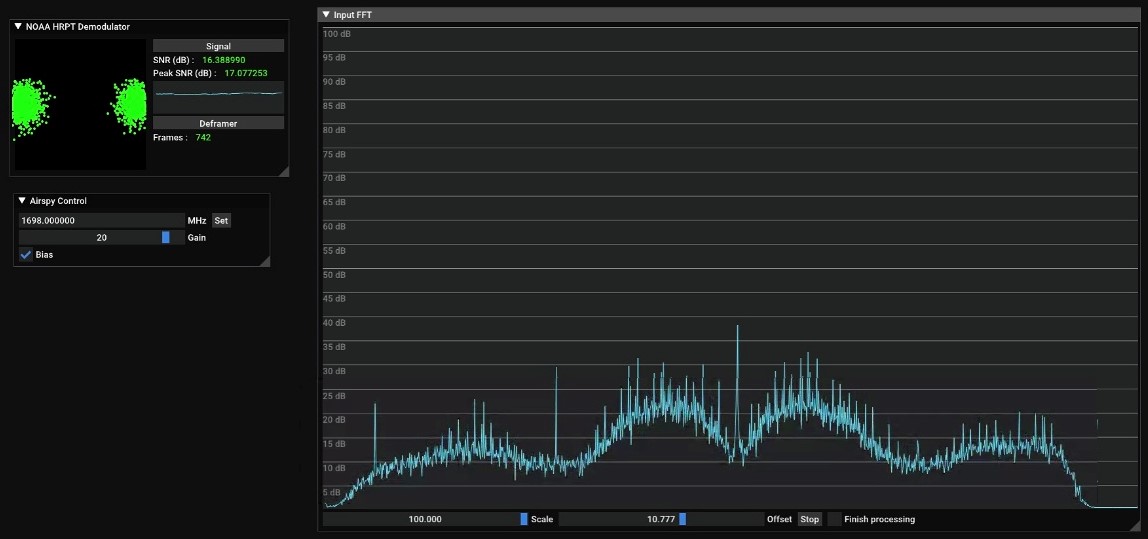 NOAA-19 live processing with SatDump
SatDump is one of the easiest tools available for HRPT signal processing. Simply select the satellite, set the frequency, configure the sample rate, and start the recording. After the pass finishes, the software automatically processes the data into images.
However, my preferred tool is LeanHRPT. I found it to be slightly more sensitive and more forgiving during temporary signal drops. LeanHRPT Demod provides a responsive demodulator, while LeanHRPT Decode offers extensive options for processing and enhancing the final imagery.
Available Satellites
Among the POES satellites, NOAA-18 and NOAA-19 provided very strong signals and consistently produced excellent results. NOAA-15 was noticeably weaker and difficult to decode reliably.
Both Meteor-M2 satellites also transmit strong HRPT signals, although they occasionally suffer from orientation issues which can degrade image quality.
MetOp-B and MetOp-C are also strong transmitters, but they can be slightly harder to acquire initially because they do not transmit a strong center carrier like NOAA or Meteor satellites.
FengYun-3B is no longer active, and FengYun-3C typically transmits HRPT only while passing over China. From my location I was only able to receive a small portion of one pass.
 A partial FengYun-3C image
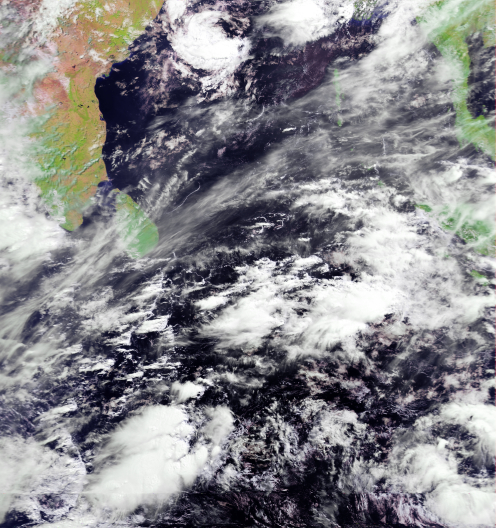
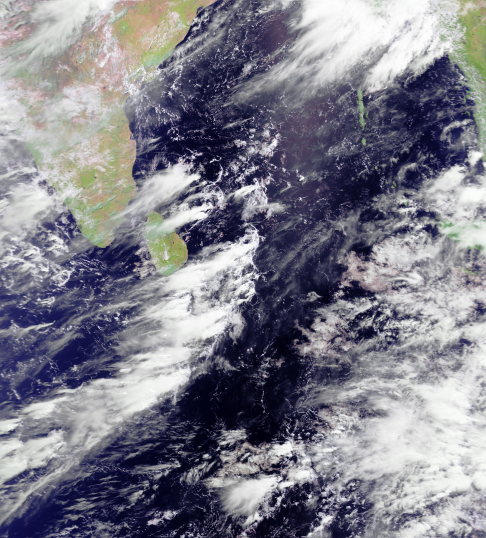
Example NOAA-19 Pass
Sample Images
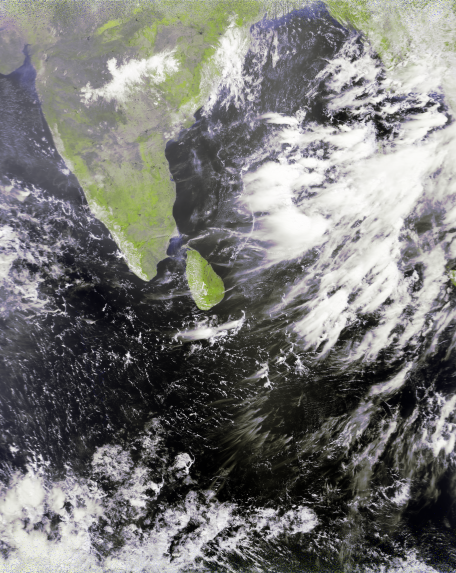
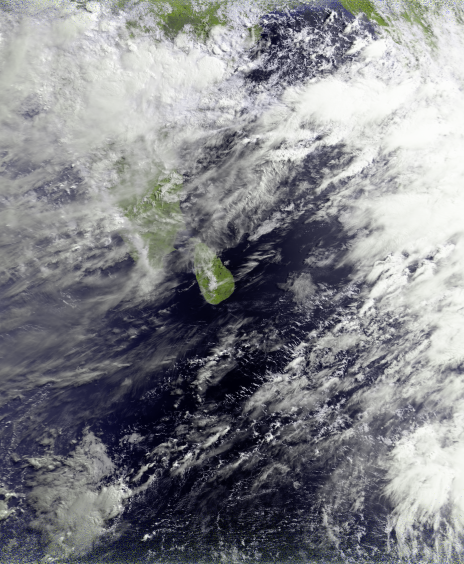
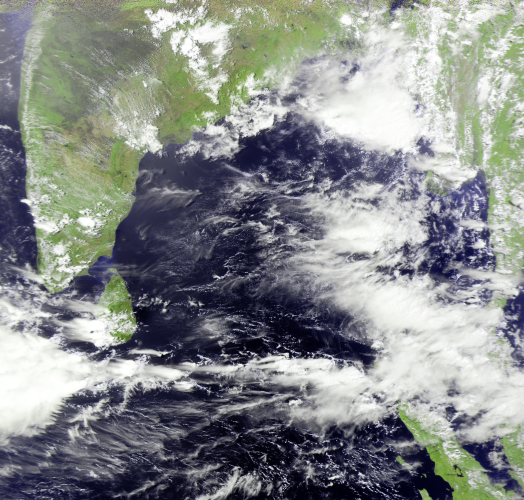
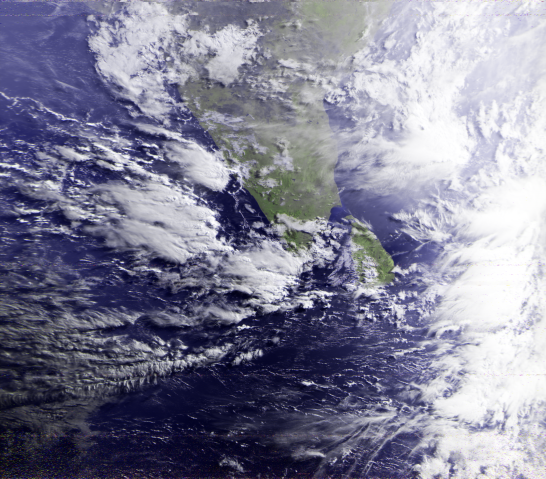

Final Thoughts
Receiving HRPT signals is both challenging and extremely rewarding. Hand tracking satellites requires practice, but it quickly becomes an enjoyable skill to develop. In my experience, passes between 55° and 75° elevation provide the best balance between tracking difficulty and pass duration.
The alignment of the helical feed is also important, and it may not match the exact position normally used by an LNB. I used the beacon signal from Elektro-L3 to optimize the feed alignment for maximum SNR.
Although building and tuning the system required significant effort, the resulting images are stunning compared to traditional APT reception. I hope my experience helps others who are interested in building their own HRPT receiving stations.
Signal Reports