
Exploring Aviation VHF ACARS
What is ACARS?
The Aircraft Communications Addressing and Reporting System (ACARS) is a digital datalink system used by aircraft to exchange short messages with ground stations and airline operations. Introduced in the late 1970s, ACARS was originally designed to automate routine tasks—such as logging departure times—to reduce crew workload and improve operational efficiency.
At its core, ACARS is a text-based messaging system for aviation. Unlike consumer messaging platforms, however, it is tightly integrated into aircraft avionics and airline infrastructure. Messages can be automatically generated by onboard systems or manually entered by the flight crew, covering everything from engine performance data to gate arrival notifications.
- VHF (Very High Frequency) — Primary for short-range, line-of-sight communication
- HF (High Frequency) — Used for long-distance oceanic communication
- SATCOM (Satellite Communication) — Provides global coverage via systems such as Inmarsat
The Evolution of ACARS
ACARS was developed in 1978 by ARINC (now part of Collins Aerospace), and its original purpose was surprisingly simple: time tracking. Airlines needed a reliable, automated way to record four key flight events, known as OOOI:
Aircraft leaves the gate (brakes released)
Aircraft takes off (weight-off-wheels)
Aircraft lands (weight-on-wheels)
Aircraft arrives at the gate (brakes set)
This automation eliminated manual logging by pilots, provided accurate flight duration data, and improved payroll and operational efficiency.
As avionics advanced, airlines realized ACARS could carry far more than simple timestamps. The system evolved into a teletype-style datalink, enabling:
- Engine Health Monitoring — Aircraft systems could automatically report faults (e.g., engine temperature exceedances)
- Weather Updates — Digital weather briefings sent directly to the cockpit
- Pre-Departure Clearances (PDC) — Reduced long and error-prone voice exchanges with ATC
This marked the transition from a logging system to a true operational communication network.
Early ACARS relied heavily on VHF, which works well over land but fails over oceans. The introduction of SATCOM in the 1990s transformed ACARS into a global system:
- Satellite ACARS via Inmarsat — Enabled communication far beyond VHF range
- FANS (Future Air Navigation System) — Aircraft could automatically report position via satellite, allowing ATC to track aircraft outside radar coverage
- Global Standardization — Two major providers—ARINC and SITA—established a worldwide ACARS network
Aircraft were now effectively "always connected," even mid-ocean.
The original ACARS system uses MSK modulation at 2400 bps—reliable, but limited. Modern aviation has gradually evolved beyond this constraint:
Higher data rates, more efficient spectrum usage
Controller–Pilot Data Link Communications
Types of ACARS Communication
118 – 137 MHz, MSK modulation, 2400 bps, line-of-sight (~200-300 km range)
2 – 30 MHz, skywave propagation, oceanic/remote coverage, variable reliability
L-band (~1.5 GHz), near-global coverage, higher latency than VHF
118 – 137 MHz, D8PSK modulation, up to 31.5 kbps, packet-based, line-of-sight (~200-300 km range)
Decoding with acarsdec

For decoding VHF ACARS, one of the most reliable and lightweight tools available is acarsdec. It is a fast, command-line decoder capable of handling multiple channels simultaneously while maintaining excellent performance—even in busy RF environments like Dubai International Airport.
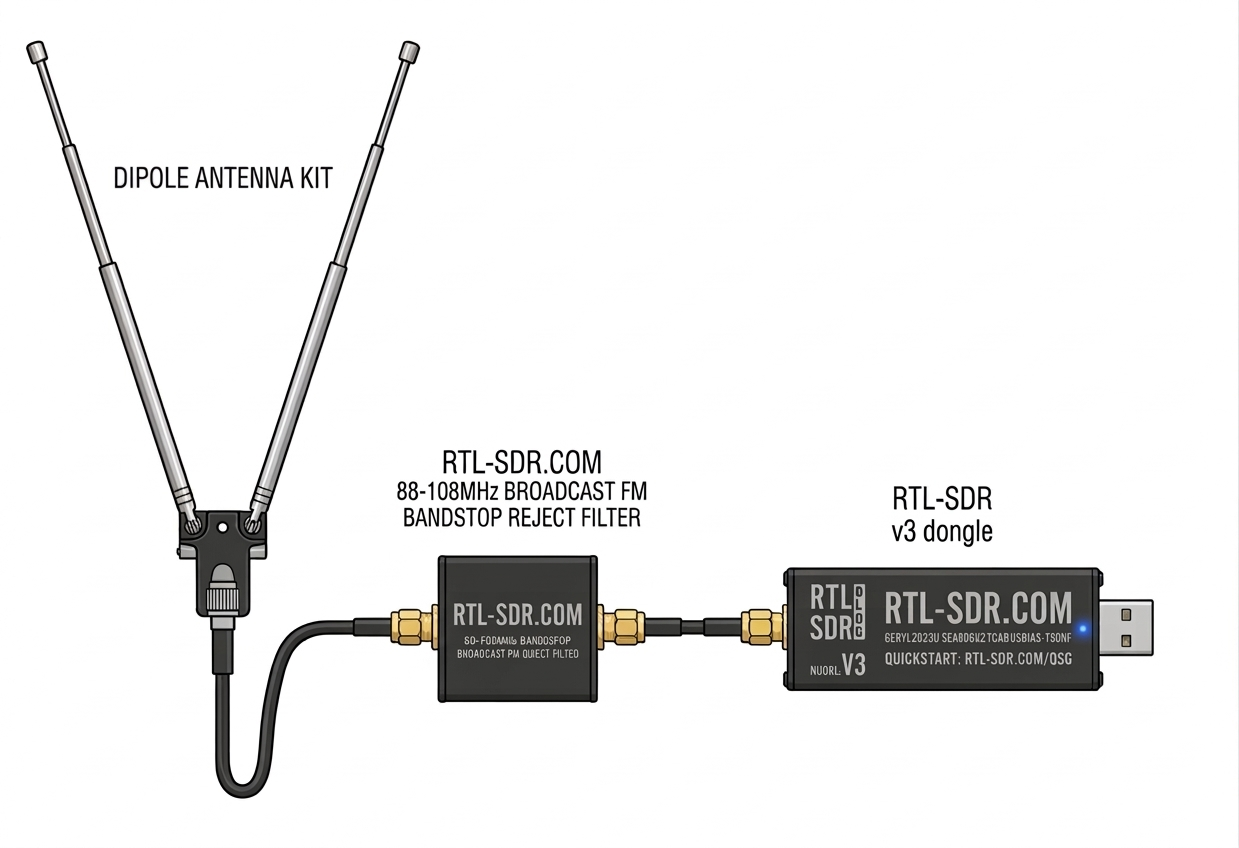
I used the RTL-SDR Blog's RTL-SDR v3 dongle paired with their FM Broadcast Band-Stop Filter to reduce FM interference. The antenna is their Dipole Antenna Kit, adjusted for the airband frequency around 131 MHz. Even without any LNAs, ACARS downlinks were very strong.
Please check :- https://github.com/f00b4r0/acarsdec/ for compilation and usage instructions.
acarsdec -e -t 1800 --output full:file:path=/home/dragonos/Desktop/decoded-acars.log --output monitor:file: --rtlsdr 0 -g 40.2 -c 131.500 131.175 131.475 131.725 131.825
Command Breakdown
- -e — Stop outputing empty messages
- -t 1800 — Set forget time in seconds on live monitor mode
- --output full:file:path=... — Save full decoded messages to log file
- --output monitor:file: — Display real-time output to terminal
- --rtlsdr 0 — Use RTL-SDR device index 0
- -g 40.2 — Set tuner gain (adjust for your environment)
- -c 131.500 — Set center frequency as 131.500Mhz
ACARS Message Types
ACARS carries a wide range of operational, technical, and control data between aircraft and ground systems. Here's what you can expect to receive:
ACARS Message Labels
Each ACARS message includes a two-character label, which indicates its purpose:
Sample Received Messages
The following are actual decoded messages received from Dubai International Airport (OMDB) and the surrounding airspace using acarsdec. These examples demonstrate the variety of operational, maintenance, and navigational data flowing through VHF ACARS.
Departure ATIS Information
[#3 (F:131.725 L:-47.8 E:0) 21/03/2026 12:09:37.734 --------------------------------
Mode : 2 Label : A9 Id : D Nak
Aircraft reg: 4R-EXQ
Reassembly: complete
/GVACBYA.TI2/OMDB DEP ATIS Z
1201Z OMDB DEP Z.
AT TIME 1200.
DEP RWY 30 RIGHT.
SFC WIND 100 DEG, 7 KT, VRB BTN 060 AND 130 DEG.
VIS CAVOK.
T 29.
DP 19.
QNH 1009 HPA.
NOSIG.
ADZ ACFT TYPE ON FST CTC.
PILOTS MUST REPORT READY FOR PUSHBACK ON DELIVERY 120. 35.
DURING PUSHBACK AND TAXI SQUAWK ASSIGNED TRANSPONDER CODE.
DEPARTURES MUST REMAIN ON TOWER FREQ AFTER TAKEOFF.
DXB VFR FREQ 126. 775.
TWY M AND N HLDG POSITION RESTRICTIONS AS PER AERONAUTICAL INFO,,,,,,,,,,,,,, PUBLICATION SECTION 2 POINT 8 AND AIRFIELD CHARTS
MNM RWY OCCUPANCY REQUIRED.
FLOW CONTROL IN FORCE.
CAUTION BIRD ACT IN THE VICINITY OF THE AERODROME.
TAILWINDS IN EXCESS OF 10 KT REP.
ADVS ATC COPIED Z.A400
This is a departure ATIS message sent via ACARS to 4R-EXQ for Dubai International Airport (OMDB), Information Z valid at 1200 UTC. Departures are on Runway 30R with winds 100° at 7 knots (variable 060°–130°), CAVOK, temperature 29°C, dew point 19°C, and QNH 1009 hPa, with no significant changes expected.
It also includes operational instructions: contact delivery for pushback, squawk assigned code during taxi, and remain on tower frequency after departure. Additional notes include taxiway M/N restrictions, minimum runway occupancy, active flow control, and cautions for bird activity and tailwinds above 10 knots.
Flight Summary Report
[#1 (F:131.175 L:-58.6 E:1) 21/03/2026 13:20:52.059 --------------------------------
Mode : 2 Label : 80 Id : 8 Nak
Aircraft reg: VT-IWV Flight id: 6E032E
No: M50B
Reassembly: complete
3501 SUMMRY 094V/21 VABB/OMDB .VT-IWV
/OUT 0950/FOB 0167
/OFF 1008/FOB 0166
/ON  1307/FOB 0093
/IN  1314/FOB 0093
/TKO F.O. /CRW
/LND F.O. /CRW
/APP N  /RWY /RVR     /ALT
/ERR    /ERR    /ERR
/CPT 74484    /FO  74451
/SO1          /SO2
/CHK
This is a flight summary (post-flight report) sent via ACARS from aircraft VT-IWV operating flight 6E032E on the route VABB (Mumbai) to OMDB (Dubai). It logs key flight events, including departure (OUT 0950, OFF 1008) and arrival times (ON 1307, IN 1314), along with fuel on board (FOB) at each stage.
Additional details include crew roles during takeoff and landing, crew IDs, and placeholders for approach data. This type of message is typically used by the airline for operational tracking, fuel monitoring, and post-flight analysis.
Precision Pilot Report
[#2 (F:131.475 L:-40.6 E:0) 21/03/2026 11:41:34.751 --------------------------------
Mode : 2 Label : H1 Id : 7 Nak
Aircraft reg: A6-ENL Flight id: EK0514
No: D42L
Sublabel: DF
Reassembly: complete
<REP512A PRECESION PILOT REPORT - GENERAL PAGE>DATE:21-03-26

LANDING:UAE527     VOHS/OMDB LAT: 25.237,LONG:  55.371,TIME:21,08:28:50,TEMP:  26.9
ENG. SD:UAE527     OMDB/OMDB LAT: 25.244,LONG:  55.349,TIME:21,08:32:14,TEMP:  27.0
TAXIOUT:UAE514     OMDB/VIDP LAT: 25.246,LONG:  55.372,TIME:21,11:19:52,TEMP:  28.4
TO/ROLL:UAE514     OMDB/VIDP LAT: 25.253,LONG:  55.375,TIME:21,11:39:18,TEMP:  28.4

PRI GRD PWR AVAIL    :21,08:39:48 ...
PRI GRD PWR NOT AVAIL:21,10:58:31 ...
SEC GRD PWR AVAIL    :21,08:39:14 ...
SEC GRD PWR NOT AVAIL:21,10:58:32 ...

PRI GRD PWR ON       :21,08:40:06 ...
PRI GRD PWR OFF      :21,10:53:31 ...
SEC GRD PWR ON       :21,08:40:03 ...
SEC GRD PWR OFF      :21,10:44:49 ...

LEFT ENGINE ON       :...
LEFT ENGINE OFF      :21,08:28:50 ...
RIGHT ENGINE ON      :...
RIGHT ENGINE OFF     :21,08:28:50 ...

PARKING BRAKE ON     :21,08:32:22 21,11:21:31 21,11:30:52 21,11:36:46 ...
PARKING BRAKE OFF    :21,11:16:42 21,11:26:45 21,11:35:32 21,11:38:42 ...

APU RUNNING          :21,08:31:38 21,10:44:45 ...
APU NOT RUNNING      :21,08:40:55 21,11:21:47 ...
APU BLEED VLV ON     :21,08:30:52 21,08:32:31 21,08:49:20 21,11:20:02 ...
APU BLEED VLV OFF    :21,08:31:28 21,08:49:19 21,11:19:55 21,11:21:35 ...

REFUELING MODE ON    :...
REFUELING MODE OFF   :...

BEACON LITE ON       :21,11:16:26 ...
BEACON LITE OFF      :21,08:32:41 ...
PWR INTERRUPT:...    :...
****************************** END  OF  REPORT *************************************
This is a precision pilot report sent via ACARS from aircraft A6-ENL operating flight EK0514. It logs detailed events for 21 March 2026, including landing and engine shutdown times, taxi-out and takeoff times, and temperatures at key positions (LAT/LONG included).
The report also tracks primary and secondary ground power availability and usage, engine start/stop times, parking brake operation, APU and bleed valve activity, refueling mode, and beacon lights. Such messages are used for operational monitoring, post-flight analysis, and aircraft system tracking.
Final Thoughts
ACARS isn't particularly fast, modern, or even efficient by today's standards—but that's not why it's interesting. What makes it compelling is that it's still everywhere. Every decode is a small piece of a much larger system: aircraft reporting their state, airlines coordinating operations, and ground networks quietly routing messages in the background.
You're not just receiving data—you're observing a system that has been evolving for decades, still doing its job. In practice, it's also a reminder that real-world RF rarely behaves perfectly. Some messages decode cleanly, others arrive incomplete, and many never make it through at all. Between overlapping transmissions, weak signals, and busy channels, what you see on your screen is only a fraction of what's actually on the air.
ACARS sits in an interesting place: old, but still relevant; simple, but deeply integrated. Whether you're using it as a first step into SDR or as a way to explore aviation systems more deeply, it offers a direct look at how aircraft communicate beyond voice—imperfect, continuous, and very much alive.
Signal Reports